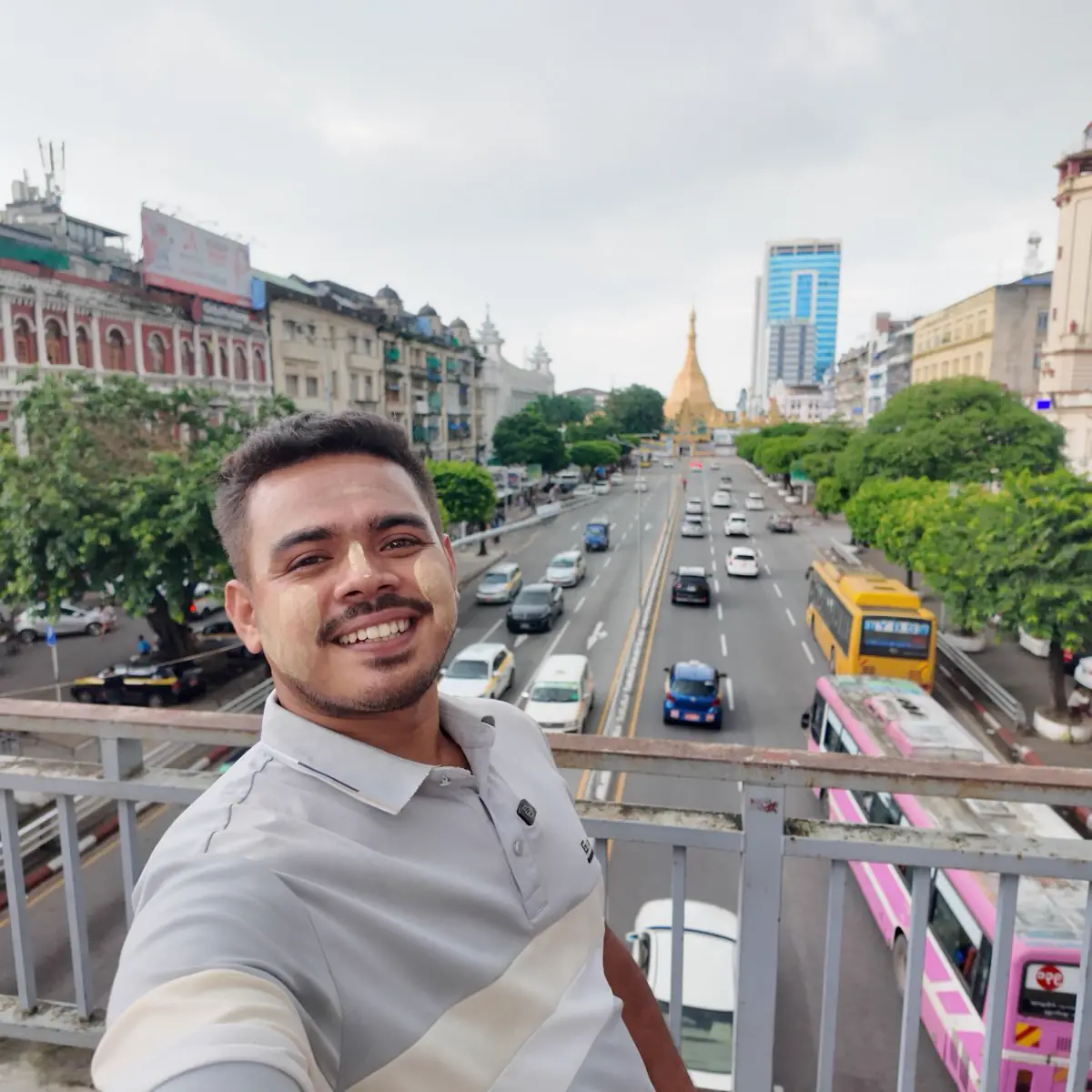
Yes, on the main tourist route — with conditions.
On the route I travelled — Yangon, Kalaw, Inle Lake, Bagan and Mandalay — daily life was calm, people were friendly, and as a foreigner I was checked far more lightly than local people. At highway checkpoints I was asked three questions at most.
Myanmar is still in an internal armed conflict, though, and some regions, including parts of Shan State, can close to foreigners. Check the latest news for every city on your list before you book, and travel with a confirmed hotel and a confirmed return ticket.
- Trip
- 9 days, 8 nights, late July 2026
- Visa
- Through an authorised agency in Dhaka, 1–2 weeks
- Flights
- No direct Dhaka–Yangon; Thai Airways via Bangkok was cheapest
- Hotel
- USD 10–20 a night (Mandalay 20–22)
- A full meal
- About BDT 300–350
- USD to kyat
- ~3,300–3,500 at the airport, ~4,000 downtown
- Social apps
- Facebook, WhatsApp, Instagram blocked without a VPN
- Whole trip
- BDT 100,000–150,000 all in
01 — The journeyThe route I took
Myanmar is the nineteenth country on my map. Before I went, almost everything I had heard about it was bad news: war, coups, refugees, a country you avoid. I wanted to see what a normal day looks like for the people who live there, so I flew in from Dhaka through Bangkok and spent nine days moving north and back again.
Here is the order it happened in. Every stop has its own full episode on Unseen AFRICA, linked under each one.
-
Yangon
The first thing that hits you, coming from Dhaka, is space. Wide roads, traffic that actually moves in lanes, clean pavements, and far fewer people than you expect in a city of millions. I rode the local bus and the train, ate breakfast where office workers eat, went into homes from the middle class to the riverside, and tried my luck with cash machines.
Episode 1: day one in Yangon · Episode 2: real life in Yangon
-
Yangon to Kalaw by bus
Kalaw is an old British hill station, cooler and greener than the plains. I took a long-distance bus up, watched the plains give way to hills, found a cheap hotel, and found halal food and a small Muslim community in town.
-
The Pa-O hills: a village, a festival and the farms
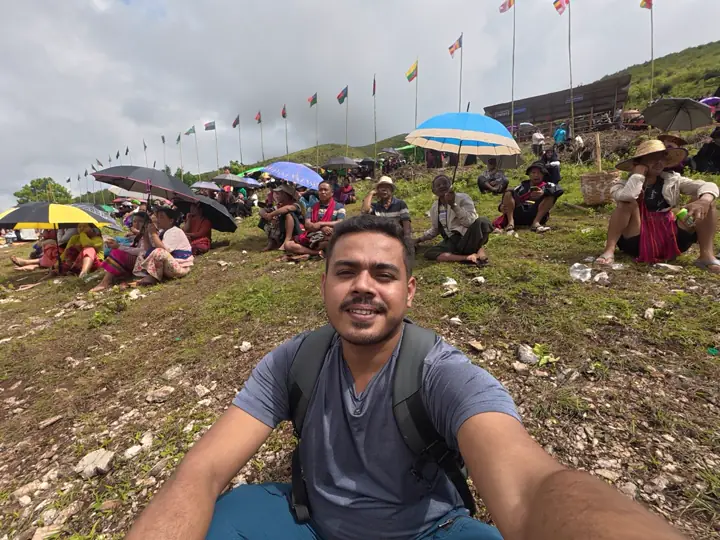
From Kalaw I went by motorbike to a village of the Pa-O people, who live from farming and bamboo basket-weaving. Then I was on a hillside packed with Pa-O families at their Rocket Festival, where home-made rockets are fired into the sky to call the rain. Further south, around Pinlaung, I walked tomato, potato and bean terraces and a five-acre avocado and dragon-fruit farm, and asked farmers what they earn and what it costs to get a crop to market.
Episode 4: village life · Episode 5: the rocket festival · Episode 6: farming in the hills
-
Inle Lake
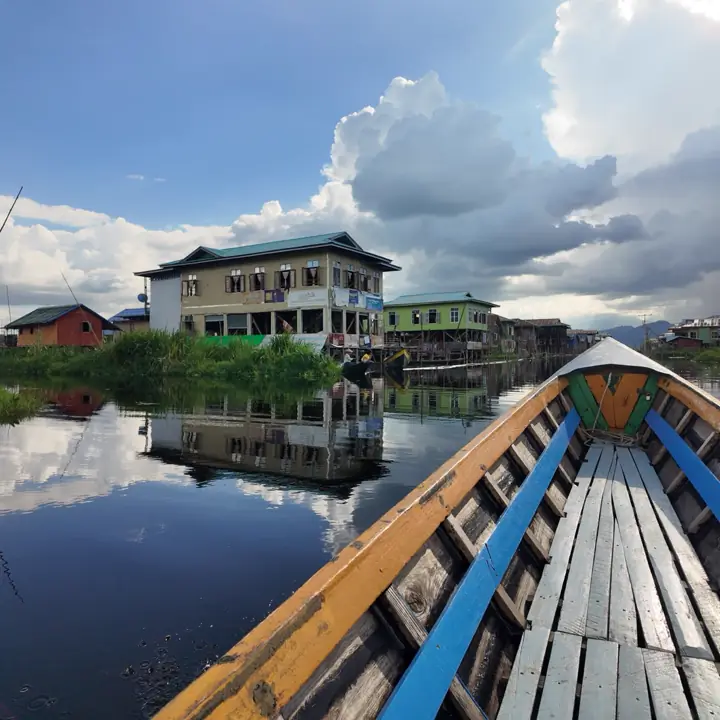
A whole society built on water. Houses on stilts, gardens that float, fishermen who row standing on one leg, and workshops weaving silk and hammering silver. On Inle the boat is the bus, the car and the delivery van.
-
Kalaw to Bagan by public microbus
This was the day I was most nervous about: a bag full of cameras, a laptop and a drone, and a road with checkpoints. It turned out to be the easiest crossing of the trip. More on that below.
-
Bagan
I hired an electric scooter, put thanaka on my face like everyone else, and rode between temples that are close to a thousand years old. That morning a Shinbyu procession came down the road — decorated elephants, horses and bullock carts taking boys to become Buddhist novices — and the whole village walked with them.
-
Mandalay
Mandalay was still marked by the March 2025 earthquake. I crossed Taungthaman Lake by boat to U Bein Bridge, met Muslim traders, ate in a Burmese halal restaurant, and — as a total stranger — was invited to a local Muslim wedding laid out on the street. On the last day I followed the Irrawaddy to a fishing community and its huge fish market.
Episode 10: Muslim life in Mandalay · Episode 11: the wedding · Episode 12: the Irrawaddy
-
Night bus back to Yangon, and home
A night coach brought me back to Yangon, where I spent my last day with an Arakan Muslim community before heading to the airport — and to the most stressful two hours of the trip.
Episode 13: Arakan Muslims in Yangon · Episode 14: the travel guide
02 — PaperworkThe Myanmar visa for Bangladeshi passport holders
This was the question I got most in the comments. There is a Myanmar embassy in Dhaka, but it does not take tourist visa applications from walk-in tourists. Tourist visas go through a small number of travel agencies the embassy has authorised. You give the agency your documents, and they come back with a sticker visa in your passport, issued in Dhaka.
- Time: one to two weeks, so don't leave it to the last minute.
- Documents: the usual simple set — passport, photos, and your bookings. The agency tells you exactly what they need.
- Who I used: I got mine through Unipal Tourism in Banani, Dhaka, who are also organising group tours to Myanmar.
A confirmed, paid hotel booking and a confirmed return ticket. I was told Bangladeshis can get an extra question or two at immigration, so have your answers and your paperwork ready. In the end nobody gave me any extra trouble — not at Yangon immigration coming in, and not leaving.
03 — Getting thereFlights from Dhaka, and when to go
As of my trip there is no direct flight between Dhaka and Yangon. You have two realistic routes:
| Route | Airline | Cost compared |
|---|---|---|
| Dhaka → Bangkok → Yangon | Thai Airways | The cheaper option. This is the one I flew, both ways. |
| Dhaka → China → Yangon | China Southern | Roughly BDT 10,000–15,000 more. |
The best months
October to February. I went in late July, in the middle of the monsoon, and Yangon reminded me of it constantly — the rain arrives without warning, hard, and then stops. Yangon is close to the coast and humid; the temperature sat in the low 20s to low 30s °C while I was there. Mandalay is hotter and drier. If you know Bangladesh's seasons, you already know Myanmar's: the winters and the monsoons feel almost the same.
04 — MoneyKyat, dollars, cards and the exchange rate
Myanmar's currency is the kyat. It's written K-Y-A-T, but you'll hear people say something closer to "chat". The single most useful thing I can tell you about money in Myanmar is this: bring cash, and change it downtown, not at the airport.
| Where you change USD | What I was offered per dollar |
|---|---|
| Yangon airport / official rate | About 3,300–3,500 kyat |
| Downtown Yangon money changers | About 4,000 kyat |
That is 500 to 700 kyat more for every dollar. The place I used is in downtown Yangon, on the opposite side of the road from Junction City shopping mall, by the market locals still call Scott Market (Bogyoke Aung San Market).
Bring clean, new, large notes
Changers are strict. If a note is old, creased or has a mark on it, they offer much less — and you'll have to take it. Bring big denominations, as crisp as you can get.
Don't count on your card
I couldn't get US dollars before I left Dhaka, so I carried euros, and by the last day they had run out. I wanted to spend a few thousand taka on small things, so I tried my Visa debit card — declined, for payment and at the ATM. A second card, issued in Mozambique, was declined too. It may have been a problem with my cards rather than with Myanmar, but the lesson is the same: work out what you'll spend and bring all of it in cash. I got stuck over a few thousand taka.
One thing that surprised me: QR-code payment is everywhere. I saw it at a restaurant in Yangon and even at a fuel pump in Mandalay.
05 — Staying connectedSIM cards, internet and the VPN problem
Without a VPN, Facebook, Instagram, WhatsApp and Messenger do not work in Myanmar — none of the big American apps did. And once the VPN is on, a network that is already slower than what we're used to at home gets slower again. Outside Yangon it's weaker still. For a normal traveller it's fine. For me, uploading and downloading video every night, it hurt.
| Option | What I paid / was quoted |
|---|---|
| SIM + 12 GB at the airport counter | About 19,000 kyat (around USD 5) |
| SIM + data pack bought in town | About 3,000 kyat (under USD 1) for roughly 5 GB |
Most shops didn't ask for my passport at all — they sold me a SIM that was already registered. Hotel Wi-Fi is usable almost everywhere and good in the better hotels.
06 — Getting aroundTaxis, buses, night coaches and domestic flights
Transport is the one thing that costs more in Myanmar than at home. The buses, though, are excellent: long-distance coaches are genuinely first class and the highways are new and smooth.
| Mode | Example | Cost | Time |
|---|---|---|---|
| Long-distance bus | Around 500 km | BDT 2,000–2,500 | — |
| Night bus | Mandalay → Yangon | BDT 2,500 | About 10 hours (left ~7 pm, in by ~6 am) |
| Domestic flight | Mandalay → Yangon | BDT 19,000–20,000 (USD 170–180) | Saves most of a day |
| Public microbus | Kalaw → Bagan, ~250 km | — | 8 am to 4 pm |
| Private car with driver | Per day | BDT 2,000–3,000+ | — |
The trade-off is simple. If you can afford the flight, take it on the long legs; by road, a transfer between two cities usually eats the whole day. If you're on a budget, take the night bus and save a hotel night.
Taxis in the cities
Taxis are the most common way to get around Yangon. You can tell them apart by the number plate: red plates are taxis, black plates are private cars, and most taxis also say "City Taxi" on the side.
Where foreigners can and can't go
Outside Yangon, foreigners can travel to the main tourist cities — Bagan, Mandalay, Heho for Inle Lake — but access to parts of Shan State, where Kalaw and Inle sit, is sometimes restricted because of the conflict there. It was open when I went. Check before you build a route around it. The quickest way to Inle is a flight from Yangon to Heho.
07 — On the roadWhat actually happens at a Myanmar checkpoint
Highway police run checkpoints on the roads between regions, and buses stop at each one. Before the Kalaw–Bagan trip I had worked myself into a state about them. Here is what happened.
As a foreigner, you show your passport. You can be asked three questions at most:
- Why have you come?
- Which city are you going to?
- Which hotel are you staying in?
That's it. I went through two checkpoints with a French tourist on the same bus. I opened my passport; the officer barely looked and said go. Same for him. Local passengers were a different story: their ID cards were checked carefully, one by one, and photographed. The government is watching movement between ethnic regions, and that attention falls on its own citizens, not on tourists.
“As a foreigner, you'll be asked three questions at most. That's it.”— Translated from the travel guide, 14:31
08 — Bed and tableHotels and halal food in Myanmar
Hotels
For USD 10–20 a night you get a very good hotel in most cities. Mandalay was a little more, around USD 20–22. Clean rooms, working Wi-Fi, hot water. This is one of the places Myanmar is very good value.
Halal food
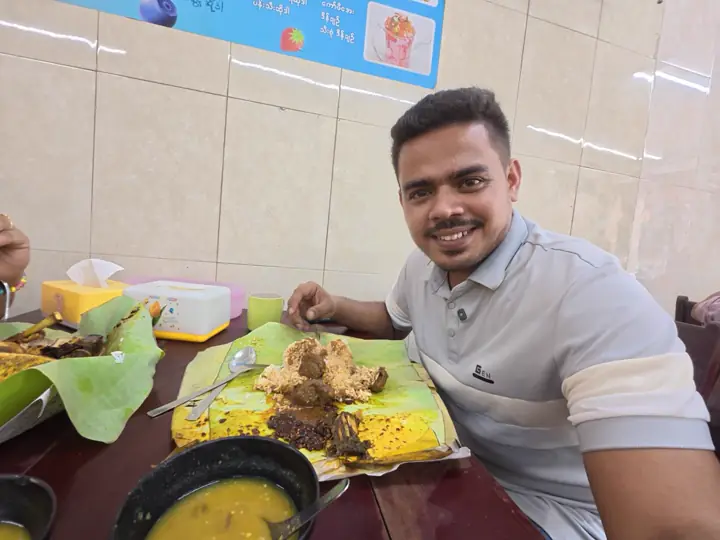
Finding halal food was easier than I expected:
- Yangon — Muslim restaurants in the downtown area, including Arakan restaurants.
- Mandalay — a real Muslim quarter, with halal Burmese restaurants, mosques and madrasas.
- Kalaw — I found a halal restaurant within hours of arriving.
- Bagan — I didn't find one. I ate at local and vegetarian restaurants instead.
A good, filling meal cost me about BDT 300–350. Prices are close to a mid-range meal in Dhaka.
09 — Must-seesWhere to go in Myanmar
If a friend asked me where to spend their days, this is what I'd say.
1. Inle Lake — go first
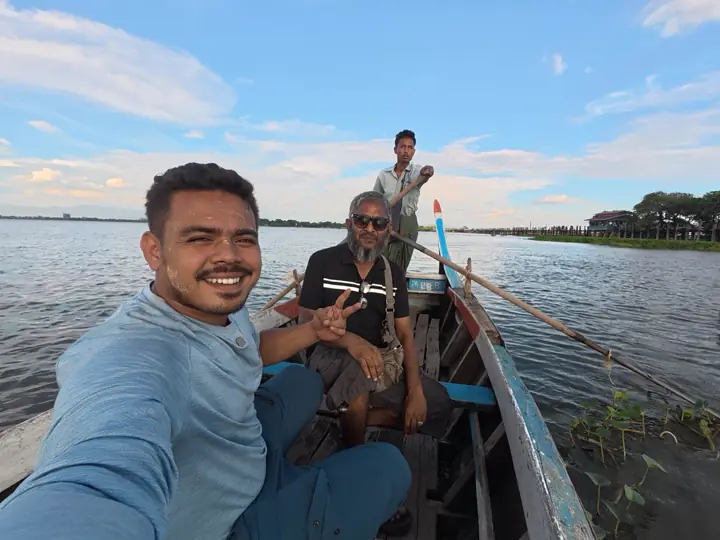
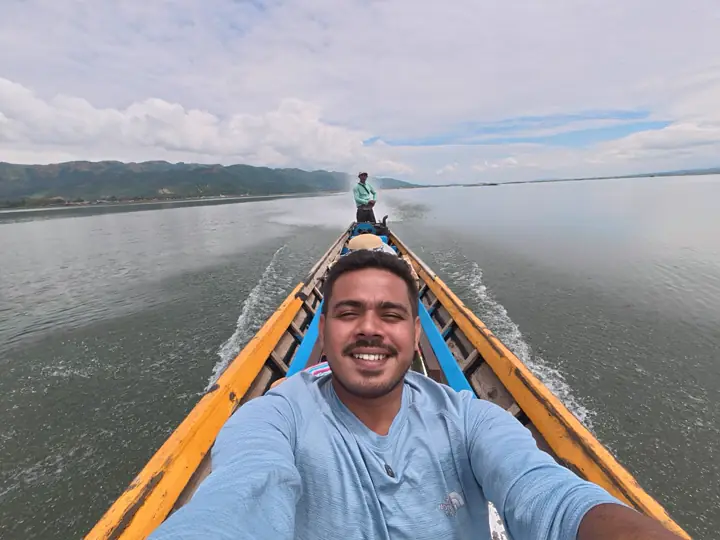
Fly from Yangon to Heho and go to Inle Lake. It is a different world. Whole villages stand on stilts over the water, crops grow on floating beds, and fishermen row standing on one leg so their hands are free for the net. Spend a full day on the water, and visit a silk-weaving workshop and a silversmith.
2. Bagan — if you care about history
Bagan was the capital of the first great Burmese kingdom, and between the 11th and 13th centuries its kings and nobles built thousands of Buddhist temples and pagodas across the plain. More than two thousand still stand, and the area is a UNESCO World Heritage Site. Rent an electric scooter and get lost between them.
3. Mandalay — the last royal capital
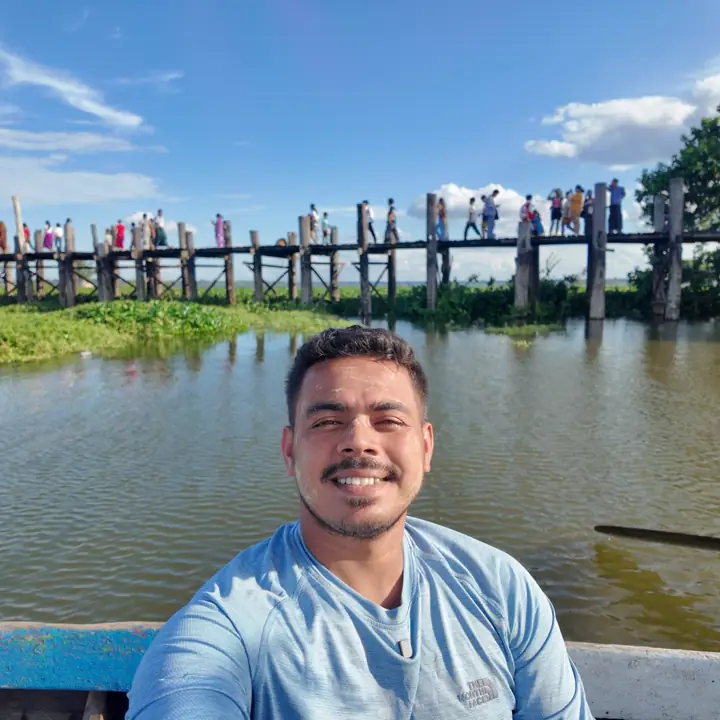
Mandalay was the last royal capital of Burma before the British took it. King Mindon's palace compound is still there, and just outside the city is U Bein Bridge: about 1.2 kilometres of teak, built roughly 175 years ago and still carrying people across Taungthaman Lake every day. Then spend time in the city itself — the Muslim quarter, the riverside along the Irrawaddy, the markets.
4. Kalaw and the Pa-O villages — for real life
If you want to see how people outside the cities live, base yourself in Kalaw for a couple of days and go out to the villages with a local guide. If your dates line up with a Pa-O festival, go.
5. Yangon — give it two days
Most people fly in and out of Yangon. Don't just pass through. Ride the local bus and train, walk downtown around Sule Pagoda, eat where the office workers eat, and change your money there.
10 — The scareTwo hours at Yangon airport after security found my drone
It was my last day. The series was filmed, I had my boarding pass and I'd cleared immigration. At the final security check before the gate, my carry-on went through the scanner — and an officer pulled it aside.
He opened it, found one camera, then another. Then he said a single word: "drone". His English didn't stretch much further. I had brought it into Myanmar knowing the country has a lot of restrictions on drones, so I had packed only what I needed — the body, the batteries and the controller — in the middle compartment. On arrival, nothing had been flagged. Now, leaving, the scanner had seen it.
They searched the bag and re-scanned it while I stood there. In the end I took the drone out myself, because the longer they had to look the worse it would get. Two or three officers gathered. They spoke in Burmese and made a phone call, probably to a superior. Then they opened my passport to the photo page, laid my boarding pass next to it, put the drone and the controller beside them — and photographed all of it together. Twice. Then they told me to go.
I didn't feel like I could go. I went straight to the washroom, took the memory cards out of the drone and both cameras, collected every spare card I had, and put them all in my trouser pocket. I hadn't filmed anything sensitive — I'd flown the drone in only two places, both with permission — but if someone came back and asked to see the footage, or told me to delete it, the whole trip would be gone. BDT 100,000 to 150,000 of my own money, and fourteen episodes.
“I got on the plane, it took off, and only then did my mind settle.”— Translated from the travel guide, 21:32
Drones are restricted in Myanmar. Get written permission before you travel, fly only where you're allowed, and be ready to explain it at security — or leave it at home. Not being stopped on arrival means nothing about departure.
11 — ContextWhat the news shows, and what I saw on the street
I want to be careful here. I was a visitor for nine days on the tourist route. What follows is what I saw and what people told me — not a complete picture of a complicated country.
The conflict
Myanmar has been in an internal armed conflict since the military took power in 2021, between the army and several ethnic armed groups and resistance forces. In the places I went, it didn't show. Markets were full, buses ran, people went to work, and I never felt I needed special precautions. But the situation can change in a region overnight, which is why the first rule is: check the latest news for each city before you go.
The press
The local press does not operate freely. Newspapers and TV go through official channels, and you can't say much against the government. People were warm with me, but some subjects simply don't get discussed in the open.
Conscription
Locals told me that military service is now compulsory for their age group — roughly 18 to their early 30s. Those who don't want to serve, they said, pay their community head a monthly fee, which locals put at around USD 20–25; those who can't pay have to go. (The military government activated its conscription law in February 2024.)
Muslims in Myanmar
I spent a lot of the series with Muslim communities, in Mandalay and in Yangon, and I was received everywhere with real warmth. People told me the hostility they feel is not aimed at all Muslims equally; the Arakan community feels it most. In Yangon I met Arakan families who have lived in the city for 30 or nearly 50 years. They describe themselves as Arakan rather than Rohingya, and one man showed me that his ID card lists his ethnicity as "Bengali". They spoke about restrictions on travel, passports and repairing mosques, and about relatives still living in Rakhine. These are individual experiences — the full episode lets them speak for themselves.
One guide, and the rest
Of everyone I dealt with, one guide was rude and difficult. Everyone else was kind. If you book a guide, agree everything — the route, the hours, the price, what's included — 100% in advance, in writing.
12 — The numbersWhat nine days in Myanmar cost
My whole trip — flights via Bangkok, a full tour with a guide that I booked before I left, hotels, food and transport — came to about BDT 100,000–150,000.
| Item | Typical cost |
|---|---|
| Hotel, per night | USD 10–20 (Mandalay USD 20–22) |
| Full meal | BDT 300–350 |
| Intercity bus, ~500 km | BDT 2,000–2,500 |
| Night bus, Mandalay → Yangon | BDT 2,500 |
| Domestic flight, Mandalay → Yangon | BDT 19,000–20,000 |
| Car with driver, per day | BDT 2,000–3,000+ |
| Local SIM with data | About 3,000 kyat (~BDT 100) |
| Flight surcharge via China vs Bangkok | +BDT 10,000–15,000 |
Don't save BDT 20,000 in the wrong place
When we travel, we all look for the cheapest package. And the cheapest packages work like this: they drop you in a city, and you're on your own. Next day, the next city, on your own again. You see almost nothing of how people live.
Think about it this way. If you're already spending at least BDT 100,000 to visit a country, the extra BDT 20,000 for a guide and real local experiences is the difference between feeling 2% of that country and 50% of it. Cutting that last 20,000 costs you most of what you went for.
13 — VerdictSo, should you go to Myanmar?
Before I went, I had heard almost nothing but negative things. What I found on the ground was the opposite. Myanmar is a tourist-friendly country. The biggest obstacle is that few people outside the tourist areas speak English, and even that won't really hold you back as a traveller. Not once did a local leave me with a bad impression. Alhamdulillah.
A brother flying home with me had spent about 26 days in Myanmar on official work. He came away just as impressed.
My recommendation: go, but go prepared. Check the latest news for every city you plan to visit. Book a confirmed hotel and a return ticket. Bring cash. Get a VPN before you land. Leave the drone at home unless you have permission. There is no reason to panic about Myanmar right now — but nobody can promise what tomorrow brings in a country with an internal conflict, so keep an eye on it.
14 — ChecklistBefore you fly to Myanmar
- Apply for the tourist visa through an authorised agency in Dhaka, at least two weeks ahead.
- Book and pay for your hotels, and print the confirmations.
- Book a confirmed return ticket.
- Check the news and your government's travel advice for each city on your route, especially anything in Shan State.
- Bring enough cash for the whole trip in clean, new, large US dollar notes.
- Plan to change money downtown, not at the airport.
- Install and test a VPN before you leave home.
- Fix your guide's route, hours and price in writing.
- Leave the drone at home, or carry written permission.
- Download offline maps and a Burmese phrasebook — English is thin outside tourist areas.
- Pack for rain if you travel between June and September.
15 — WatchThe full travel guide, in Bangla
Everything above, in my own words and on location, filmed on my last day in Myanmar. 28 minutes, in Bangla.
Watch “মিয়ানমার কি সত্যিই নিরাপদ? ৯ দিনের বাস্তব অভিজ্ঞতা” on YouTube
16 — FAQQuestions people ask about travelling to Myanmar
Is Myanmar safe for tourists in 2026?
On the main tourist route — Yangon, Kalaw, Inle Lake, Bagan and Mandalay — it felt safe in late July 2026. Daily life was calm, people were friendly, and foreigners were checked far more lightly than locals. Myanmar is still in an internal armed conflict, so some regions, including parts of Shan State, can close to foreigners at short notice. Check the latest news and your government's travel advice for each city before you book.
How do Bangladeshi passport holders get a Myanmar tourist visa?
The Myanmar embassy in Dhaka doesn't take tourist visa applications from walk-in tourists. You apply through one of its authorised travel agencies, which collect your documents and get a sticker visa issued in Dhaka. It took one to two weeks. I used Unipal Tourism in Banani. Carry a confirmed, paid hotel booking and a confirmed return ticket when you fly.
Is there a direct flight from Dhaka to Yangon?
Not at the time of my trip (July 2026). The usual options are Thai Airways via Bangkok or China Southern via China. Bangkok was the cheaper route; via China cost roughly BDT 10,000–15,000 more.
How much does a trip to Myanmar cost from Bangladesh?
My nine-day, eight-night trip cost about BDT 100,000–150,000 in total, including flights and a pre-booked guided tour. A very good hotel is USD 10–20 a night (USD 20–22 in Mandalay), a full meal about BDT 300–350, and a 500 km intercity bus about BDT 2,000–2,500.
What is the best time to visit Myanmar?
October to February. I went in late July, during the monsoon, when Yangon gets heavy rain without warning. Mandalay is hotter and drier than Yangon.
Do foreign debit cards and ATMs work in Myanmar?
Don't rely on them. On my last day, my Visa debit card and a second card issued in Mozambique were both declined, for payments and for cash withdrawals. Bring enough cash for the whole trip in large, clean, new US dollar notes — old or marked notes get a much worse rate.
What is the exchange rate from US dollars to kyat?
On the day I filmed, the airport offered about 3,300–3,500 kyat per dollar, while money changers in downtown Yangon, opposite Junction City near Bogyoke (Scott) Market, offered about 4,000. Rates move quickly, so compare before you change.
Do Facebook, WhatsApp and Instagram work in Myanmar?
Not without a VPN. Facebook, Instagram, WhatsApp and Messenger were all blocked, and a VPN makes the already slow mobile network slower. A local SIM is cheap: about 3,000 kyat (under USD 1) bought around 5 GB, while the airport counter quoted about 19,000 kyat for a SIM with 12 GB.
Can I find halal food in Myanmar?
Yes. Yangon, Mandalay and Kalaw all have Muslim-run halal restaurants. In Bagan I didn't find one, and ate at local and vegetarian restaurants instead.
What happens at highway checkpoints in Myanmar?
Highway police stop buses between regions. Foreigners show their passport and are asked three questions at most: why you're travelling, where you're going and which hotel you're staying in. At two checkpoints the officers barely looked at my passport or a French tourist's, while local passengers' ID cards were checked closely and photographed.
Can I take a drone to Myanmar?
Drones are restricted. Get written permission before you travel or leave it at home. Mine wasn't flagged on arrival but was found at the final security check at Yangon airport on the way out; officers photographed it with my passport and boarding pass, sent the photos to a superior, and let me board.
How many days do you need in Myanmar?
Nine days was enough for Yangon, Kalaw and the Pa-O villages, Inle Lake, Bagan and Mandalay — but only because my tour was booked in advance. Road transfers between cities can take a full day, so add a buffer day or fly the longest legs.
17 — The seriesAll fourteen Myanmar episodes
The whole journey, in order, on Unseen AFRICA. Published between 17 August and 3 October 2026, the series passed 3.3 million views in its first seven weeks.
 0141:56Myanmar during wartime: what I saw on day oneYangon · 17 Aug 2026
 0225:25What is real life like in Yangon?Yangon · 23 Aug 2026
 0333:39By bus from Yangon to Kalawমিয়ানমারের বাসে কালাওয়ের পথেKalaw · 26 Aug 2026
 0425:51Village life: from Kalaw to a Pa-O villageমিয়ানমারের গ্রামীণ জীবন কেমন?Shan State · 28 Aug 2026
 0527:03Rockets for rain: the Pa-O Rocket Festivalবৃষ্টির জন্য আকাশে রকেট!Shan State · 31 Aug 2026
 0629:48How farmers live in the hills of Shan Stateমিয়ানমারের পাহাড়ে কৃষকদের জীবনPinlaung · 2 Sep 2026
 0739:36Inle Lake: houses on water, life on boatsপানির ওপর ঘরবাড়ি, নৌকাতেই চলে পুরো জীবন!Inle Lake · 7 Sep 2026
 0830:02Kalaw to Bagan: what happens at checkpointsচেকপোস্টে আসলে কী হয়?Kalaw → Bagan · 14 Sep 2026
 0945:21Behind the pagodas: 900-year-old Baganমিয়ানমারে প্যাগোডার আড়ালে!Bagan · 16 Sep 2026
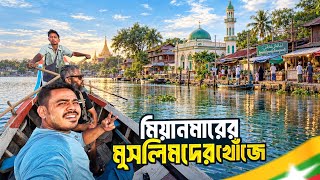 1034:17Looking for Myanmar's Muslims: Mandalay and halal foodমিয়ানমারে মুসলিমদের খোঁজেMandalay · 21 Sep 2026
 1130:43Inside Mandalay's Muslim quarter, and a weddingমায়ানমারের মুসলিম পাড়াMandalay · 25 Sep 2026
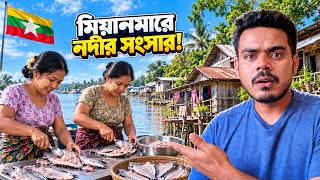 1230:57Life along the Irrawaddy Riverমিয়ানমারে নদী নির্ভর ঘর-সংসারMandalay · 27 Sep 2026
 1325:53How Arakan Muslims live in Yangonমিয়ানমারে আরাকান মুসলিমরাYangon · 29 Sep 2026
 1428:02Is Myanmar really safe? The travel guideমিয়ানমার কি সত্যিই নিরাপদ?Yangon airport · 3 Oct 2026
Saif Afrisian
Saif is a Bangladeshi travel filmmaker. He makes long-form travel documentaries in Bangla on Unseen AFRICA (429K subscribers) and has filmed in 19 countries across Africa and Asia, from Kenya, Uganda and Malawi to Pakistan, Sri Lanka and Myanmar. His work reaches 1.7 million followers across platforms and has been featured on Bangladeshi national television, including Somoy TV and Ekattor TV.
NotesHow this guide was made
- Written from Saif's own trip to Myanmar in late July 2026 and the fourteen episodes filmed on it. Timestamped links point to the moment in the travel guide video where each point is made.
- Prices, exchange rates, visa process, SIM packages, route access and security experiences are from the time of travel and will change. Check with the embassy, your airline and official sources before you go.
- Views of the conflict, conscription and community life are individual experiences shared with Saif, not a statement about everyone in Myanmar.
- Photo dates come from the camera files. Series view count as of 6 October 2026.