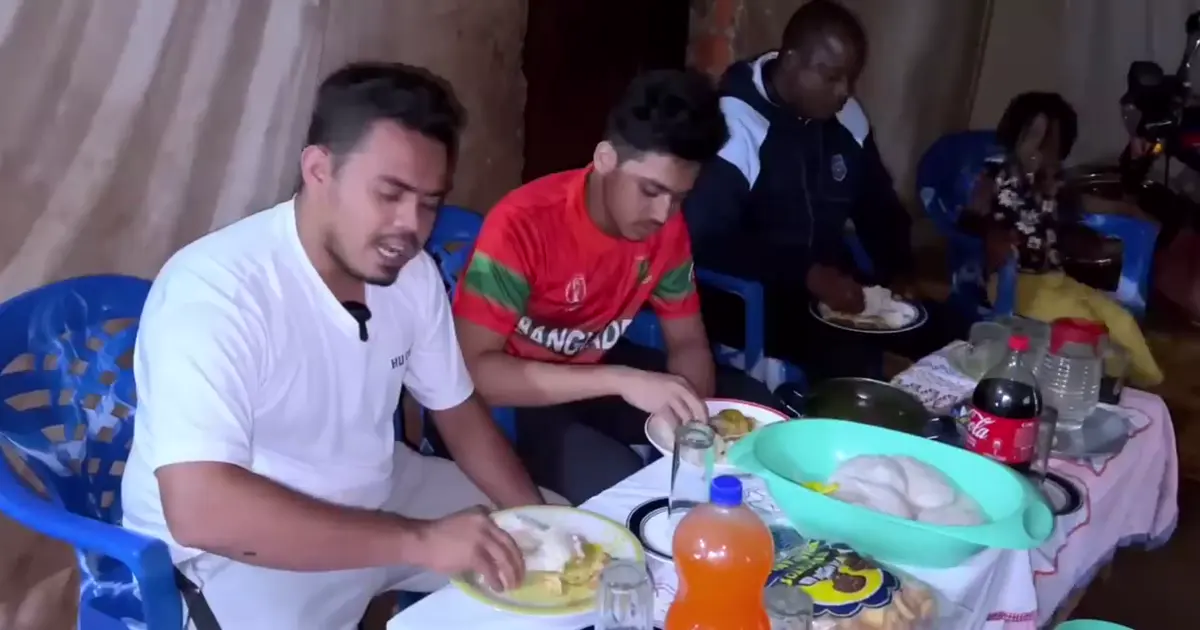
“When a guest comes, chicken is a must.”
The man of the house said it walking me across his yard. Not fish. Not another curry. Chicken first, then anything else.
“This is our African custom. We honour a guest with chicken.”
That day, I sat at his table. Weeks earlier, a village headman had sent me home with a live chicken. And a few months later, I turned up at a third home with my own arms full.
The guest is honoured with chicken, and nobody leaves empty-handed.
In the Mozambique villages I have lived in since 2018, hospitality has clear rules. A guest is served chicken before anything else; families call it their African custom. Hosts set out chairs and soft drinks, cook masa (xima) or rice, and often send a guest home with a gift, sometimes a live chicken.
01 — January 2023“Come in with your sandals. No problem.”
“Welcome! Welcome!”
That was how we were met at the house I called the Master's house, Master bari. I had brought my younger brother along, in his red and green Bangladesh cricket jersey.
“This is my younger brother,” I said.
“Yes, I know him,” the Master said. Then, as we crossed the yard: “Watch your step.”
At the house he told me: “Come in with your sandals. No problem!”
Inside, the table was already laid. A white cloth, plates with glasses turned upside down on them, bottles of Fanta and Coke. “Sit. Sit here.”
“Are you sitting too?” I asked.
“Sit, sit. I'll sit too.”
02 — The customThe chicken rule
Before lunch, he walked me around the place.
His brother-in-law came over to say good afternoon. We passed a small shop. “Whose shop is this?” I asked. “My wife's,” he said. “Just a few goods, nothing much.”
Then he explained the rule.
“When a guest comes, chicken is essential. No other curry. It has to be chicken. After the chicken, something else. This is our African custom.”— The Master
03 — At the table“My first child died”
Sitting at that table, the talk turned to children.
Then the Master told me something.
“My first child died.”
And right after: “More children are God's blessing.”
Later, outside, he introduced his wife: “My wife.” The talk came back to children, and he said this.
“Whatever it is, it's a gift from the Creator. A child is a child.”
04 — Lunch“Rice, or masa?”
“Can you eat it if we cook it our way?” they asked.
Then they wanted to be sure of something. “Your country's name is Bangladesh, isn't it?”
I pointed to my brother's jersey. “Here it is! This is our country's name. Bangladesh!” Bangladesh, in Asia.
When the food was ready, the question came: “African food. Will you have rice, or masa?” Masa is what people here call xima, the stiff maize porridge everyone eats.
“Either one is fine!”
I began in the name of Allah, and ate the masa and curry with my hand. It was really tasty.
And when we finished, I said what we say at home after every meal: Alhamdulillah.
05 — December 2022The headman with 478 bigha
A month earlier, I had visited a very different kind of home.
The man was the village matbor, the headman. The title of my video about him says it: four wives, 28 children.
“You really are the big man of this area,” I told him.
“No. There are others like me.”
“You're the biggest!”
His compound had mango trees everywhere. Small local mangoes, and bigger farm varieties. “Those are foreign?” I asked. “A different variety,” he said. “Foreign, like me,” I said.
His sons farm small plots of their own and store the harvest at his place, he said. “They're trying to build something of their own too.”
I asked how much farmland he had. 64 hectares. In our measure, about 478 bigha.
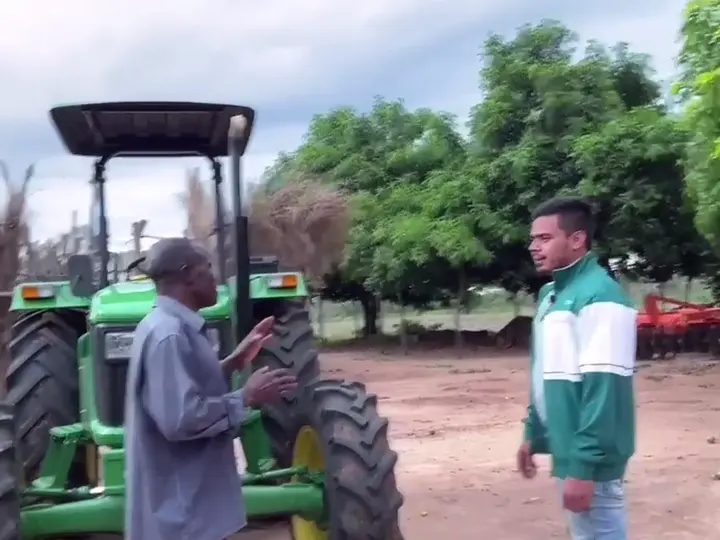
Then there was the green tractor. He got it by applying for it, he said, and pays it off over five years, once a year.
“A lot of people want a life like this, but they don't get it.”
“That's certainly true. The Creator has given it to you.”
“Yes. The Creator is great.”
His wives? Out working in the fields, a little way off.
06 — LeavingA chicken to take home
Before I left, the yard turned into a chase.
Children ran after the chickens. “Did they catch it? Catch another one! Let me see how!”
I asked him to call all his children so we could take a photo together. Then someone held out a chicken to me.
“This… is for me?”
“For you to eat.”
He gave me the chicken to take home and cook. That is the other half of the rule: a guest doesn't only eat chicken here. A guest leaves with one.
“Thank you so much. I really liked it. I liked everything.”
On the way out I was shown one last thing. During the coronavirus, they kept water in one spot, so anyone who came could wash their hands there. Nice technique!
07 — April 2023This time, the gifts came from you
“This is the first time a foreigner has come to my house. And with all of this.”
He was the orange farmer from one of my earlier videos, and many of you commented on it. This time I didn't come to be fed. I came with gifts from you, my viewers.
I unpacked them one by one, on a blue sheet under his grass shelter. Biscuits, for his morning breakfast. Cooking oil. Spices. Salt. Noodles. A sack of rice. A shirt, and another shirt. Something warm for the cold season. Trousers, and another pair. Shoes.
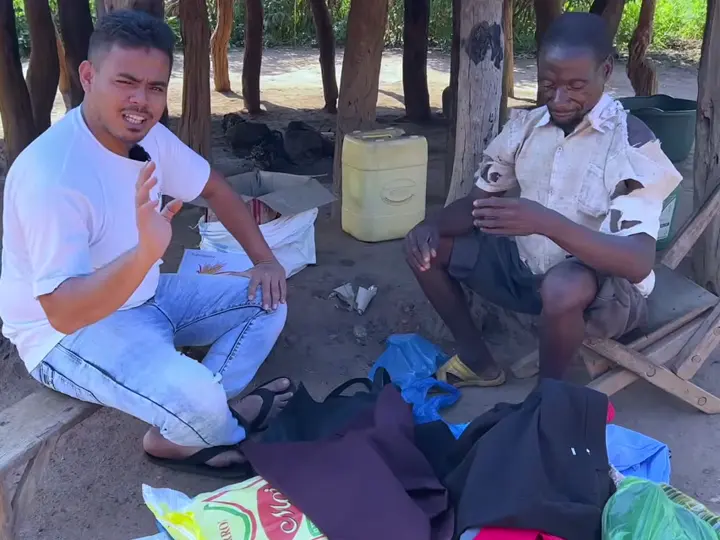
“All of this is yours. From my Bangladeshi brothers.”
“Thank you so much!” he said.
“Don't thank me. Thank the Bangladeshis.”— Me, to the orange farmer
He thanked me for bringing it all, and asked me to pass his thanks to the people who sent it. So: thank you, from him.
Then I pointed at the torn clothes he was wearing. “Don't wear these any more.”
“All right.”
He hasn't remarried since his divorce in 2009, he told me. He doesn't drink, he doesn't smoke. And how many children in all? He doesn't know the total.
Afterwards he walked me through his orange trees.
WatchSit down to lunch with us
Watch “আফ্রিকার মাষ্টার বাড়ীতে বাংলাদেশির দাওয়াত!” on YouTube · 1.7 million views


FAQQuestions people ask about African hospitality
How do people in Mozambique treat guests?
In the villages I know, a guest is welcomed into the house and seated at a laid table. Hosts told me a guest must be served chicken, which they call their African custom, and guests are often sent home with a gift.
Why do African families serve chicken to guests?
A host in Mozambique told me that when a guest comes, chicken is essential: no other curry first, chicken first and something else after. He called honouring a guest with chicken their African custom.
What food is served to guests in rural Mozambique?
I was served chicken with masa, the local name for xima, a stiff maize porridge, along with soft drinks. I was also offered rice instead.
Do African hosts give gifts to guests?
Often, in my experience. A village headman in Mozambique gave me a chicken to take home and cook, and on another visit a family gave me a live chicken after lunch.
How much farmland does a village headman in Mozambique have?
The headman I visited in December 2022 told me he had 64 hectares of farmland, about 478 bigha. He was paying off a tractor in yearly instalments over five years.
Do your viewers help the people in your videos?
Yes. In April 2023, I took gifts from my viewers to an orange farmer from an earlier video: rice, oil, spices, salt, noodles, biscuits, clothes and shoes.