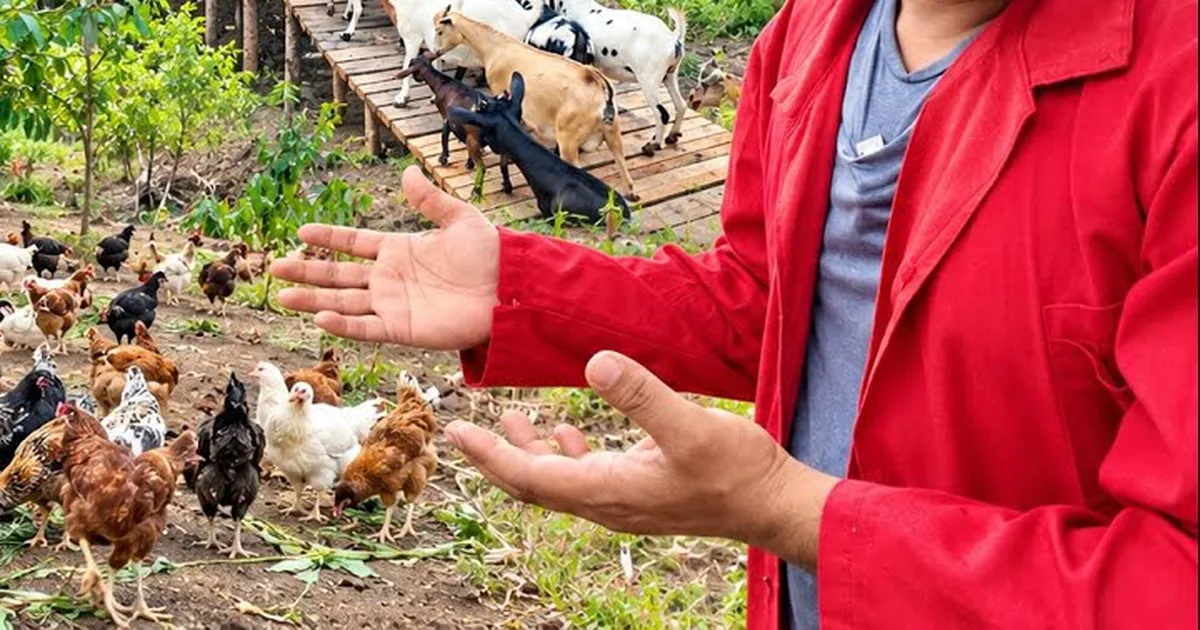
A year earlier I had shown you this farm. 178 acres, in rural Uganda.
Now I stood next to its owner again, and I made a complaint to his face.
“He keeps pouring money into this soil. Pouring and pouring. I can't see a visible profit.”
Farming in Uganda is not quick money. It needs capital, skill and years of patience.
Many Bangladeshis have come to Uganda to farm, and not all of them succeeded. I filmed Nizam bhai's farm in 2025 and 2026. More than 400 goats died at the start, and the management changed three times. My verdict: you need capital, market knowledge, skilled people, regular management, and five to ten years.
01 — The dreamThey came to grow gold in this soil
Bangladeshis have come to Uganda from everywhere. From Bangladesh, the Middle East, Europe, America, Australia.
They came with one dream: farming. Many started commercial farms. But not everyone succeeded. As far as I have seen, a big part of them lost money. Many have fallen flat on their faces.
So I went back to the one farm I knew well, to learn the truth from the owner himself.
We left Kampala, the capital, late in the afternoon. About two to two and a half hours later we were close to the village dirt road.
All along the way I saw trees full of flowers. I couldn't tell what they were. Then I saw the beans. Coffee trees! They lined both sides of the road through the whole village.
Nobody here grows it as a business. People just have coffee in their yards, the way we have coriander seedlings in front of our houses at home.
02 — A year onFrom 178 acres to 302
The next morning I turned up dressed like Nizam bhai, in the same red farm coat.
The farm is called NUHA Agro Farm. On my first visit, in 2025, it was about 178 acres. Now, he told me, it was 302.
He had bought 80 acres beside the highway, where there had been a gap next to his land. Then 52 acres in another place, then 14 and a few small pieces. All of it joined to the land he already had.
On my first visit there were about 22 ponds. Since then he had cut 10 more big ones. There were new sheds for goats and new sheds for chicks. In a new plot, his men were clearing ground for potatoes, pumpkins and cucumbers, just for the farm's own kitchen.
I asked what my first video had done to him. Many people had called, messaged and come to see the farm. “Nothing negative,” he said. “It was all positive.”
03 — The complaint“Where is the profit?”
So I said it to his face. The farm keeps growing. Where is the profit?
“Easy to say, hard to do,” Nizam bhai said.
From the start, he told me, he has gone slowly. Step by step. He doesn't want to put a big amount in one place and have it stuck there.
Was the money coming from his electrical-goods business? No. Since he began in business, he has never taken money out of one business to pour into another. “That causes trouble on both sides.” He was building the farm slowly, with his own personal income.
He started with a few cows and goats, paid for from his own pocket. From January 2025 he began turning it into a commercial farm. That brought its own problems. Cows need grass and fodder. Chickens need feed.
He had just put about 8,000 local chickens into new sheds, and he was planning for many more. “Within one year,” he told me, “you will see the change.”
In a shop, he said, you can see the stock. On a farm, much of the work doesn't show.
04 — The learning“I'm not really a farmer”
Nizam bhai said it himself. He isn't a farmer by trade.
As a child he saw his father and brothers farm a little at home. But he grew up mostly away from the village, in Chittagong, in his father's business. Then Dubai. Then Uganda.
He had an established business in Kampala, selling electrical goods he imported from China, from several shops. When I visited, he had lived in Uganda for 15 years.
“The system in Bangladesh and the system here are totally different,” he told me. His first two or three years on the farm were all learning. If a goat fell sick, what could it be? What treatment? What medicine?
So I asked the big question. How much did that learning cost you?
“I won't call it a loss,” he said. “When you go to school, you don't call it a loss. You are gaining knowledge.”
I pushed. How much, then? He didn't think it was right to say. “But it was a lot.”
By then the management had changed three times. What he had put in place, he told me, was the final management.
05 — The biggest loss700 goats, and the night they came in the rain
I asked him about the biggest loss he has had here.
At the start he had more than 700 goats. More than 400 of them died.
Some came from about 400 kilometres away. They travelled at night, in an open truck, in the rain. When they arrived they had pneumonia.
The next day he was treating them. While he did, the goats around them fell sick too. Then they died.
In Bangladesh, he said, a few goats get wet in the rain and nothing happens. He had seen the same in Ugandan villages. With two goats, that's fine. With a big herd, one sick animal makes the others sick, and they take a long time to recover.
“The way we kept two goats in the village, farming doesn't work like that. I didn't understand that.”
The lesson he took: goats and sheep can't be mixed. Since then, he said, goats are kept on one side and sheep on the other.
06 — The peopleThree fish, and the people who run the farm
Then Nizam bhai picked up a fishing net, and the day got lighter.
He threw it into a pond while I filmed. Then, three fish. “Our honour is saved, Nizam bhai!”
For him, the farm is a place to take a little time off from life and relax the mind.
One of the men told me about the fish. Some tilapia were six to a kilo. Bigger ones, two to a kilo, or one. There are magur catfish too, about seven or eight kilos, even ten. They caught two magur and let them go again.
For lunch, there was fried tilapia and cut tomato. The spices were mostly Ugandan, with some from Bangladesh.
When I visited, five Bangladeshis worked on the farm, each in charge of a section. One handled building work and looked after the fish and ponds. One was a doctor for the animals. One ran the vegetables. The chicken section was in the charge of a young local woman in a Bangladesh T-shirt, with Rasel bhai from Noakhali beside her.
Mohammad Habib had been there a year and a month. Carpenter, mason, “an all-rounder”, he said.
In the chicken section I met a young man four months into his first time abroad. In Bangladesh he did sales work. When will he go home? “As long as my rizq is here, I'll stay. I can't stay beyond my rizq by force.”
He was honest about the hard part. He has arguments with the local workers, about the work. When they do less, more of it falls on him. And when it rains, rain gets in the chickens' eyes. They stop eating, and many die.
Then rain was on its way, and he went back to herd his chickens inside.
07 — The moneyCan the farm run on its own income? Yes. It costs him something else.
I asked him one hard question. If no money came from outside for three months, could the farm run on its own income?
“Of course. At present it has that capacity, alhamdulillah.”
Which parts earn best? Cattle, goats, fish and chicken. In this area and this weather, he said, fish is in a good position. Then chicken, which needs little investment. Cattle and goats need more.
The biggest cost is the workers' wages. Then feed. Cattle cost the most of all the animals, because they need more people and a lot of grass.
The buyers are local Ugandans and people from Kampala, who come and take fish, chickens and ducks. For big batches, they call in buyers from outside. They sell fish every day. Once, they sold about a tonne at one go.
Had the farm's value doubled since my first visit? “No, not doubled. But it has gone up a little.”
And he isn't done. He told me his plan needs at least 500 acres. In the future he wants a meat processing plant and a fish processing plant, mainly to export to the Gulf.
But the farm began as his hobby. It grew until he couldn't run it alongside his business any more. A few days earlier he had told me he was tired. He told me he wanted someone who could take on the full management and live on the farm.
Then he told me about his children.
He used to take his children out every Saturday and Sunday, and often Friday too. “For the last four years, I haven't been able to take my children anywhere. Only because of the farm.” Now is their age for going out, he said. When they grow up, they'll be busy.
So why keep going? “When I come here and see these trees and these animals, I feel peace.”
08 — The adviceWhat he tells every Bangladeshi who wants to farm here
Many Bangladeshis have lost money on projects here. Many were misled. I asked Nizam bhai why.
“What people say in videos, and what you see physically, are totally different,” he said.
His advice: come first. See. Listen. Understand. Then do business. He has seen people come here and hand over money, told that this exists and that exists. When they arrived, there was nothing like it. “It's a lack of understanding.”
Many people think a few thousand dollars and a plane ticket are enough to start a farm here. I asked him about that. “It doesn't work like that, brother.” Just living here costs money every month, and there are other costs on top.
If your capital is small, he said, don't start with a farm. Start a small trading business, step by step. Add farming later. “Farming is a long-time investment.”
“There's a good future here,” he told me. “But you have to understand it. It may be slow. There may be no profit for a year or two. But it will come, inshallah.”
09 — My verdictWhat I expected to see, and what I saw
I'll be honest. I used to think business is always business.
I expected to come back after a year and see him in a car several times more expensive. I expected to hear the farm's value had doubled. Many of you probably expected the same. A year ago he told me about many plans. Many of them I could now see. A big part, not yet.
But I walked every corner of this farm, a year apart, and heard every new story. And I felt this: farming business is not for those who don't have patience.
However big the investment, you have to move ahead steadily for at least five to ten years. Everyone stumbles, at the start, in the middle, or along the way. Getting past that is not an easy journey.
Farming is for people with big financial backing. Or for people with the patience to wait a long time for a promise to come true.
Profit, risk, pressure or loss: you can't say it in one sentence. That is farming everywhere in the world, not only in Uganda.
But this much is real. Many Bangladeshis have come to Uganda. Many visited and left without finding land they liked. Many were cheated through investments. I have seen several of them with my own eyes. I've seen them come, and I've seen them go.
“Uganda's soil is full of promise. But buying land doesn't make a farm succeed.”
You need the capital, knowledge of the market, skilled people and regular management. Nizam bhai's farm showed me that you can learn from your mistakes and move ahead. But make the decision only when you understand the full, real numbers.
WatchWalk the farm with me
Watch “উগান্ডায় কৃষি ব্যবসায় বাংলাদেশিরা কেন লোকসান করছেন?” on YouTube

FAQQuestions people ask about farming in Uganda
Is farming in Uganda profitable?
It can be, but slowly. When I went back to Nizam bhai's farm in 2026, he told me it could run on its own income, but the value had not doubled, and he had paid a lot to learn. I'd say plan on five to ten years.
Why do some Bangladeshis lose money farming in Uganda?
From what I saw and heard: they invest without coming to see for themselves, some are misled, they bring too little capital, and they expect a farm to work like a few animals in a village. Running a farm well also needs skilled people and steady management.
How much money do I need to start farming in Uganda?
I won't give a figure, because costs change. Nizam bhai told me a few thousand dollars is not enough, since living there costs money every month, and there are other costs on top. Go and see it on the ground, and check the rules and costs with official sources first.
Which farming works best in Uganda?
On Nizam bhai's farm, he said fish did best for that area and weather, then chicken, which needs little investment. Cattle and goats need more investment. His biggest cost was workers' wages, then feed.
What happened to the goats on the farm?
At the start he had more than 700 goats, and more than 400 died. Some were brought about 400 kilometres in an open truck at night in the rain, arrived with pneumonia and spread it to the others. Now he keeps goats and sheep apart.
Where is NUHA Agro Farm?
It is in Luweero, in rural Uganda. From Kampala, it took me about two to two and a half hours by road to get close to the village.
Should I start with a farm or a business in Uganda?
Nizam bhai's advice: if your capital is small, start with a small trading business, step by step, and add farming later. He called farming a long-time investment.