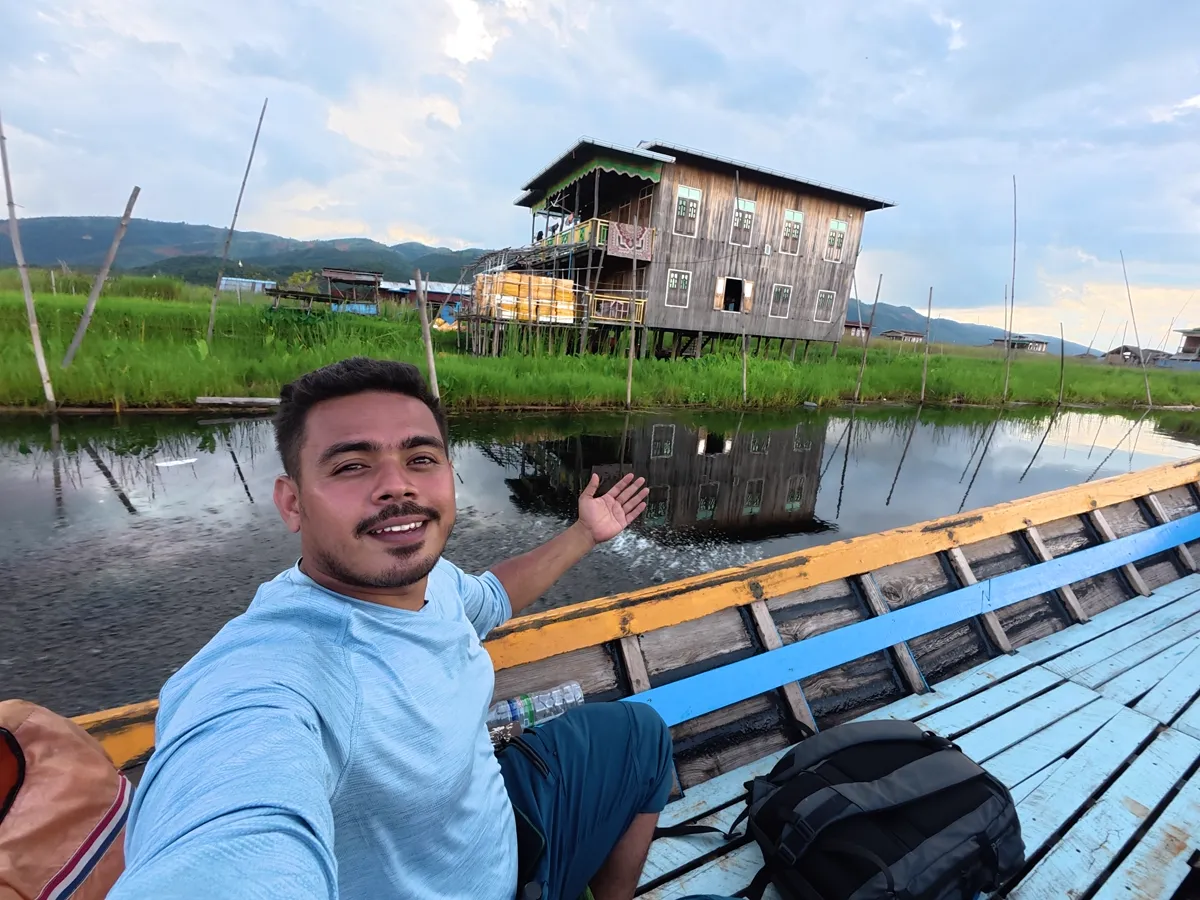
An old man asked me to sit, and started making tea.
He lived alone in a bamboo house whose walls had gone black inside. He had no income.
Yet his floor was covered with mats for guests. There were cups and glasses, and soap and powder his neighbours had brought.
I didn't speak his language. The house told me how his village works.
My practical guide to this trip, with the visa, money and checkpoints, is Is Myanmar safe to visit? This post is about the people.
What is village life like in Myanmar?
In late July 2026 I spent days in the hills of Shan State and on Inle Lake. In a Pa-O village, the neighbours looked after an old man with no income. In the hill fields, women did most of the work. On Inle Lake, people farm on floating beds and go everywhere by boat, even to school.
01 — The villagePermission first, then “mingalaba”
At the edge of the village, a few men stood by the road. We had to ask them before we went in.
That morning, 24 July 2026, I was in Kalaw, about 1,300 metres up in Shan State. Locals call it mini Switzerland. It sits in cloud most of the time. When the sun breaks through, the hills light up.
A little before nine I set off by motorbike for a Pa-O village. The paved town road slowly turned into hill roads and village tracks. The further I went, the further I left the tourist world behind.
At the gate, permission was asked and given. Rain fell like mist. I tried my Burmese: “Mingalaba.” Hello.
There was a festival nearby that day, so most people hadn't gone to work. Men wore lungis. One led his cattle out to plough. Tomatoes, rice and vegetables grew on the slopes.
Better-off families lived in two-storey houses, each with a vehicle to bring the crops in. Poorer homes had walls of woven bamboo and a ladder to the door. You take your sandals off to go up.
In one house, the woman knew Bangladesh. The men of the house had never heard the name.
02 — The old manHe had no income. His village made sure that wasn't the end of it.
Green tea or black? He said one word: “khai”. Khai means strong.
Two neighbours had come to see him. Another watched from the road and laughed at the whole scene.
He was old, and he lived alone. I think he had a sister, married into a village nearby. He had no way to earn.
So the people around him, young and old, each gave him something. That is the village's tradition. If anyone goes hungry, or has no income, everyone helps them together.
Inside, the bamboo walls had turned completely black. I'm not sure if they burn them to make them that way. His kitchen was in one corner. He was Buddhist, and he prayed here, under a tin roof.
Many mats lay on the floor, for all the people who came to see him. Cups and glasses for guests. Soap, powder, so many things the neighbours had left.
The house was about 61 years old. We had come into his home, so I told the camera: let's at least leave him something.
03 — The festivalA festival for rain, and many peoples on one hillside
Then the whole village climbed onto trucks.
The festival was on a hillside about 30 to 40 kilometres in from Kalaw. People came from villages 10 to 20 kilometres around. I had hired a local guide, because almost nobody there spoke English.
The festival is about farming. When the rain stays away for days, people here pray for rain. It is held every July in that area, though the exact date changes.
It is mainly a Pa-O festival. But other ethnic groups came too, Shan and Danu among them. I had never seen anything like it. Honestly, I felt like an alien.
Group after group arrived with drums and dancing. Each carried its own home-made rocket, tied to a bamboo frame. They could tell I was a foreigner, so they danced a little extra for me.
At the stalls I found snacks I knew. The Burmese food we buy in Cox's Bazar comes from here, after all. One cake tasted like our taal pitha. Another, they called khaja, just as we do.
When I said I was from Bangladesh, many people knew it. We are neighbouring countries. Yet we knew almost nothing of each other's culture, customs or daily life.
Each group keeps its own calendar, with its own year. It's like our Bangla calendar beside the English one. But full moon and new moon fall on the same days in all of them.
The best rocket wins a cash prize. Some groups hadn't come to compete at all, though. They came for tradition, and for fun. The prize isn't the main thing. Keeping the tradition going, year after year, is.
One festival, many peoples, many cultures. Festivals like this hold a country's people together. Every country has them.
04 — The launchI carried a rocket on my shoulder. Then its fuse went out.
Half a kilometre down the road, someone blocked the way, like a railway crossing. A rocket was about to be lit.
The first launch I watched belonged to another group. Fire, and then it dropped onto the stage. Some of the crowd left.
Then I remembered what I had done. Earlier, I had carried a rocket on my shoulder and danced with a Pa-O group. Now that rocket was going up.
If it failed, most people would say I had jinxed it.
Only the group's own people may go near the launch pad. So I waited with everyone else. Everyone was tense. So was I.
They lit the fuse. The flame ran along the cord, and died before it reached the rocket.
I thought they had been disqualified. It was like a lamp going out before it lights.
Then I learned each group gets two tries. My team came back and lit it again.
It flew. Nothing spectacular, but it went up, and it saved their honour.
Later, another group's rocket looked like the winner. I guessed mine came third or fourth. I never found out where they finished.
We ate in a tent. Before the egg fried rice came a cup of hot water with a couple of tea leaves, chopped coriander and a pinch of salt. At home, a restaurant gives you a glass of water. Here, it is this.
Before we left, I asked my guide where to relieve myself. In the forest, he said. But first you have to say sorry to nature.
05 — The hill farmsI couldn't understand them, and they couldn't understand me
The women in the fields laughed when I called them dadi, bubu and chachi.
These were villages in the hills around Pinlaung, with no tourists, only farmers. Tomatoes, potatoes, beans and rice grew on the slopes. People coming home from the festival recognised me on the road.
Burmese is Myanmar's official language. Shan, Karen, Kachin, Chin, Mon, Rakhine and many more are spoken too. Talking was hard, and my guide helped where he could.
“After a few hours with them, I felt you can know people without understanding their language.”
The soil was red. If I looked only at the ground, I'd have thought I was in a remote African village. Even their hoes were as long as the ones in Africa, so you needn't bend and tire.
A woman earthed up her potatoes, with beans and pumpkin planted between the rows, just as we do at home. Plants were tied with rope made from bamboo skin. Most faces wore thanaka, a powder like sandalwood.
I didn't see a single man doing this work, only one farm owner. Everywhere else, the women did it, as in our own hill regions. They carried small baskets on their shoulders, and umbrellas, because rain comes any time. At half past five, they went home.
They had questions for me too. Foreigners have a lot of money, they said. They don't have to work. They can travel to other countries, like me, in Myanmar.
And they told me something quieter. The Pa-O say their lives are short. Farming is their main work, and life passes in hard labour.
Rich and poor differ all over the world, among farmers too. A few kilometres on, a five-acre farm stood behind a wire fence: avocado, papaya and dragon fruit, with pumpkins planted under the dragon fruit. A big investment.
In a dry field, women lifted rice seedlings into net sacks, to move them where there was water. Just like at home.
Then we got lost. You've seen Africa's jungle with me. This was Myanmar's. Children were still playing as dusk fell. At last we found the road. By then it was 7:20 pm, almost dark.
06 — Inle LakeWhy would anyone live on water, with so much empty land?
Travel the roads around Yangon and you pass huge stretches of land where nobody lives.
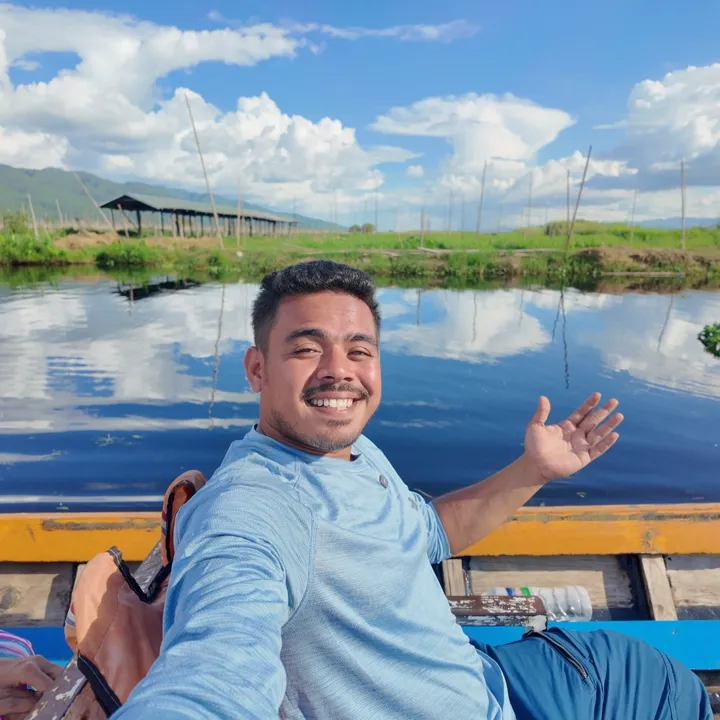
So on 25 July, when I set out on Inle Lake with a local guide and a boatman, I had one question. Why take on a life this hard, on the water?
Their roads are water. The lanes run one way in and one way out, marked with red flags. Under each house there is parking for a boat. Families with money keep their own.
A shop had customers. They had come by boat and parked outside. Here, the boat is the car.
Children went to school by boat. There was a school on the water, and the teachers came by boat too. A health centre. A point that supplies drinking water. Washing drying on a boat. A boat packed with people: the public transport.
I couldn't have imagined that such a life existed in Myanmar.
At home, when water collects on the road, we can't walk. Here, without water, they can't move. And the water never runs out. We keep rebuilding our roads. Theirs have carried people for hundreds of years, and they never need rebuilding.
Then I saw a bridge, my first one on the lake. It was about half a kilometre long and about 20 years old. It was built for schoolchildren, because boats between two villages had a hard time. Until then, I had only climbed the steps of private houses and shops.
I am grateful first to Allah, then to you who watch. It was written for me, so I could come here and show you.
07 — The answerTheir farms float, so a flood can't drown them
Our farmers live in fear of floods. Inle's farmers don't.
They gather water hyacinth and plants from the bottom of the lake and heap them into beds. On top they grow taro and tomatoes.
When the water rises, the beds rise with it. The crop can't drown.
And the beds don't drift away. Rows of wooden and bamboo poles hold each one in place.
Everything, from planting to picking, is done from a boat that moves between the beds. The beds aren't temporary. They stay.
The tomatoes grown here go all over the country. Fishing is the other big living. I watched a boat ice a large catch, to send around Myanmar.
There was my answer. The water isn't a problem here. It is the road, the farm and the living.
The lake looked deep to me. It isn't. I learned that it has grown shallower, as silt, pollution and water plants build up. That is Inle's biggest challenge.
One more question stayed with me. If everything here happens on the water, where do they bury the dead?
Not in the water. Most people here are Buddhist. The body is taken to a cemetery or cremation ground outside the lake. Many are cremated, and some communities bury. The ambulance is a boat.
People here are born on the water and grow up on the water. They go to school, college and market by boat. Even the first part of their last journey is by boat.
I wrote about Inle's stilt houses and one-leg rowing in my Myanmar travel guide.
08 — The IrrawaddyOn the river, most homes stand on the bank. A few stand in the water.
On my last afternoon in Mandalay, a friend drove me 8 to 10 kilometres out of the centre in his CNG.
He is a professional photographer who also drives a CNG. We were going to see a community on the Irrawaddy. I'm not sure “slum” is the right word. People there told me poorer families live here.
At the entrance stood an ambulance, and another nearby. Not a hospital's. The neighbourhood keeps them, so help can come at once.
Close to the river, I thought mostly fishermen would live here. No. Colony-style houses held people of every trade, and Hindus, Muslims, Buddhists and Christians. Whatever people's main income was, it was tied to fish one way or another.
Nearby, children were playing marbles. The same game we played as children.
On the river itself, I saw a house, and beside it, a small room: their washroom. People stood on boards to wash clothes. Others fished with rods. I saw children in school uniform too.
At the jetty, a man in a lungi and vest had a pistol at his waist, beside a policeman in uniform. He kept looking at me as I filmed. I smiled and raised a hand. He smiled and nodded. So friendly.
The fish market was clean. Nothing lay around. Huge prawns. Fish scraped clean with a spoon. Roe, and fish drying for shutki. One fish was so big I asked my viewers to tell me its name.
I thanked my CNG friend. Without him, I might never have seen these places.
WatchCome out on Inle Lake with me
Watch “পানির ওপর ঘরবাড়ি, নৌকাতেই চলে পুরো জীবন!” on YouTube
 25:51From Kalaw to a Pa-O villageমিয়ানমারের গ্রামীণ জীবন কেমন?August 2026
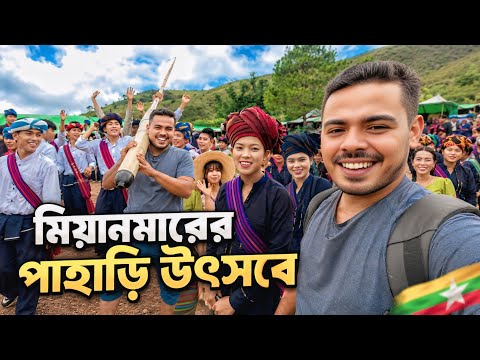 27:03Rockets for rain: the Pa-O festivalবৃষ্টির জন্য আকাশে রকেট!August 2026
 29:48Farmers in the hills of Shan Stateমিয়ানমারের পাহাড়ে কৃষকদের জীবন কেমন?September 2026
 30:57Life along the Irrawaddy, and the night busমিয়ানমারে নদী নির্ভর ঘর-সংসারSeptember 2026
All fourteen episodes of the series are listed in my Myanmar travel guide.
FAQQuestions people ask about village life in Myanmar
What is village life like in Myanmar?
In the Shan hills in July 2026, I saw people living from farming on the slopes and ploughing with cattle. In a Pa-O village, neighbours looked after an old man with no income. In the fields, women did most of the work. That is what I saw, not the whole country.
Who are the Pa-O people?
The Pa-O are one of Myanmar's ethnic groups. The village I visited near Kalaw, in Shan State, was a Pa-O village, and the rocket festival I went to was mainly theirs.
What is the rocket festival in Myanmar's Shan hills?
It is a festival tied to farming and prayers for rain. In July 2026 I went to one about 30 to 40 kilometres from Kalaw. Groups from several ethnic groups brought home-made rockets, launched them, and competed for a prize. It is held every July in that area, on a date that changes.
How do the floating gardens on Inle Lake work?
Farmers gather water hyacinth and plants from the lake bottom, heap them into beds and grow taro and tomatoes on top. Wooden and bamboo poles hold the beds in rows. When the water rises, the beds rise too, so a flood can't drown the crop.
How do children get to school on Inle Lake?
By boat. When I was there in July 2026, I saw a school built on the water, and the children and teachers came by boat.
Do people on the Irrawaddy in Mandalay live on the water?
Not most of them. The community I visited, 8 to 10 kilometres from central Mandalay, lived mostly in colony-style houses on the bank. A few houses and washrooms stood on the water, and nearly everyone's work was tied to fish.
Do people in Myanmar know Bangladesh?
Some do. In a Pa-O village, the men of one house had never heard of it. At the rocket festival the same day, many people told me they knew it.