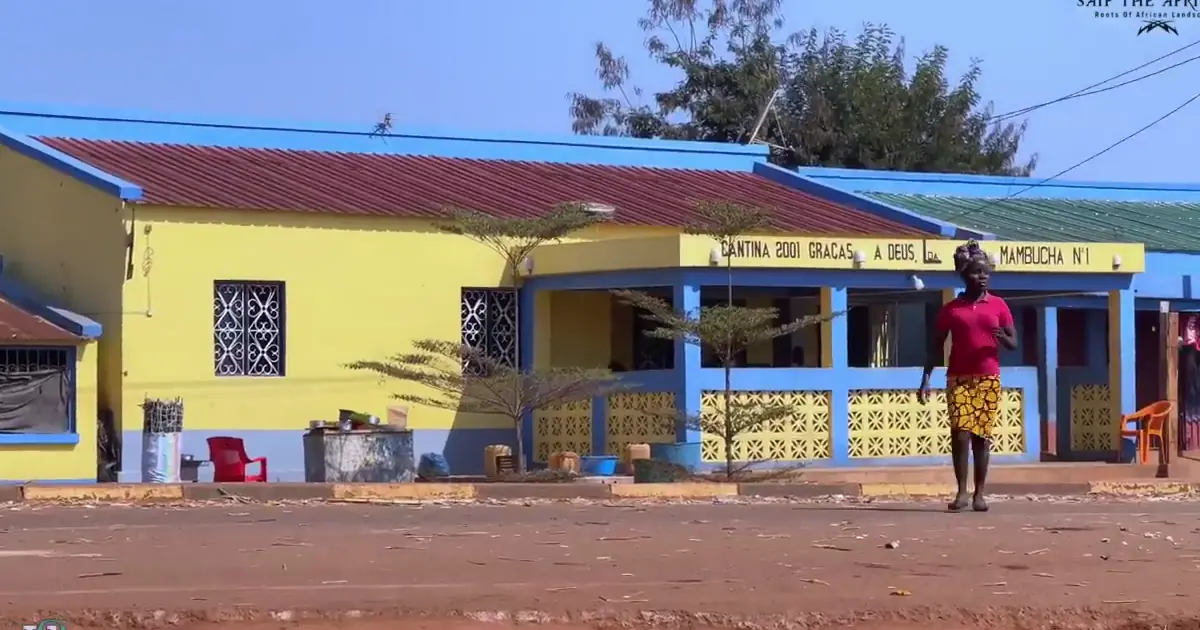
Two shops stand side by side in a market in Mozambique. One is yellow. One is blue.
The owner of the yellow shop has seven wives. The owner of the blue one has two.
When we hear that a man has more than one wife, we already have a picture in our heads. I had one too.
So I went inside.
In the families I filmed, every wife had a part in the family's work.
In the Mozambique villages I filmed in 2023, polygamy came with work. The wives ran shops, farmed the fields and ran a maize mill. The man with the most wives was the richest man in the area. And the co-wives who shared one yard lived with little or no quarrelling. That is what I saw, family by family.
01 — The yellow shopSeven wives, five shops
The woman behind the counter was not a shop assistant. She was the owner's wife.
The yellow shop is like a grocery shop at home. The owner has five shops in this one market.
Here is the interesting part. No man works behind the counter. His wife runs it, and the staff who work with her are always women. It is the same in his other shops.
He is the most influential man in this area, and the wealthiest. A businessman with five shops, big and small, and a wife in each of them. He has farmland too.
02 — The blue shopTwo wives, side by side
Inside the blue shop, two women sat next to each other, talking and laughing.
Cosmetics on the left. Groceries on the right. And the two women in front of the shelves were both wives of the shop's owner.
Two co-wives, sotin as we say in Bangla, in one small shop all day. Look how easily they talk to each other.
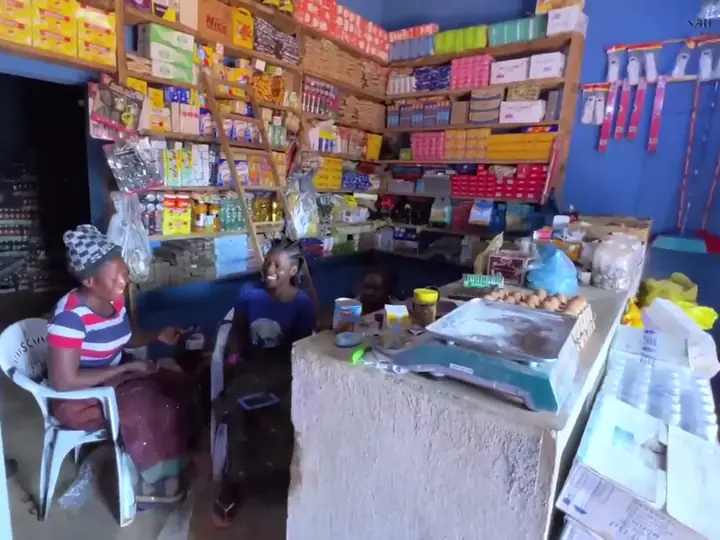
Their husband has two shops in the market. He sits in one of them himself.
03 — July 2023Five wives, 18 children, and a yard like a village
“It feels like this whole place is a village.”
That is what I said when I walked in. I had lived here five years by then. In ten kilometres around, I had not seen as many houses as stood inside this one yard.
One man owns all of it. He is the husband of five wives and the father of 18 children. The yard holds 16 rooms. I joked that this was the president's residence.

My guide was his eldest son, Costa, in class 12. He showed me the walls, built of brick and plastered with three kinds of soil, so the house has three colours. Solar panels for the lights. A store room just for water containers.
Everyone here works. Maize is the main crop. Near his house he has a shop that sells everything from sandals and sunglasses to headphones. Beside it, he sews clothes for the village on his machine. In the maize and sesame season, farmers bring him a few kilos at a time to sell.
The work is shared out among his wives too. One stays at home. One runs his maize mill, where villagers bring their maize by the bucket. The others work in the fields.
I couldn't stay for lunch that day. So, the way people do here, they sent me home with a chicken.
04 — August 2023“If it's meat, both must get meat”
His dream house was finally finished. Red brick and mud, built his own way, with bricks you can get right here.
He lives in it with two wives. He introduced them to me: the first wife, and the second.

Inside, he showed me a room for the children. Then his own room. I teased him: “And the boy's mother? She doesn't get one?”
Later I asked the question everyone asks.
“You live with two wives together. Don't you ever have fights?”
“No.”
Then he explained how.
“If you buy one piece of clothing, you have to buy it for both. You can't buy meat for one and bones for the other. If it's meat, both must get meat.”— The husband
“Do they cook in the same pot?” I asked.
“No. One cooks there, the other cooks here. But after cooking, they sit and eat together.”
05 — December 2022The headman's four wives
Some of you will remember the village headman, the matbor, with 64 hectares of farmland.
He has four wives and 28 children. One wife is always at home. The other three are always in the fields. He is one of the biggest farmers in his area.
Walking past his houses, he pointed them out to me. “Two of them live in this house. One in this one.”
I wrote about my visit to him, and the chicken he sent me home with, in my post on African hospitality.
06 — What I noticedSo why do some men marry more than once?
I can't give you one reason. I can tell you what kept showing up.
In every family, the wives were part of the work. One ran a shop. One ran a mill. Others farmed. And the man with seven wives was the richest man around.
Then there is the thing many of you notice in my videos. Several wives live in one yard. Sometimes under one roof, like one family.
“Do you all live here?” I asked one family.
“All in one house.”
What surprised me most: between the co-wives, I usually saw no fighting, or very little. They live their lives in their own way, and they looked comfortable doing it.
Here, a man may have one wife, or two. Sometimes five. Sometimes seven.
WatchWalk through the two shops with me
Watch “আফ্রিকার মানুষ একাধিক বিয়ে করে কেন?” on YouTube · 818,000 views


FAQQuestions people ask about polygamy in Africa
Why do some men in Africa have more than one wife?
I can only speak for the Mozambique families I filmed in 2023. In each of them the wives shared the family's work, running shops, a maize mill and the farms, and the man with the most wives was the wealthiest in his area.
Do co-wives in Africa get along?
In the families I visited, co-wives living in one yard usually had no fights, or very few. One husband told me that whatever he buys, clothes or meat, he must buy equally for both wives.
Do co-wives live in the same house?
Often in the same yard, and sometimes in the same house. A village headman showed me that two of his wives live in one house and one in another, and another family told me they all live in one house.
Do co-wives cook together?
Not in the family I asked. Each of the two wives cooks in her own place, and after cooking they sit and eat together.
How many children does a man with several wives have?
It varies. Of the men I met, the one with five wives had 18 children, and the village headman with four wives had 28.
Where did you film these families?
In villages and a market town in Mozambique, where I lived and worked, between December 2022 and August 2023.